|
Warming ocean: so fish move northMay 21, 2007Courtesy of Far North Science The warming ocean off Alaska's vast coast has triggered an unprecedented ecological seachange that began in the late 1970s and has continued into the new century. 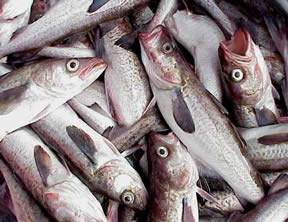 Walleye Pollock AFSC-NOAA Walleye Pollock AFSC-NOAA
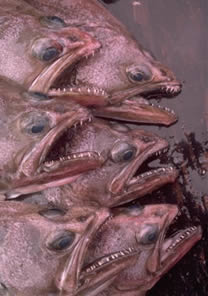
It's often called the "regime shift" - where an ocean once crawling with crab and shrimp and forage fish fattened up with goggle-eyed groundfish like pollock and strange, difficult-to-eat predators like arrowtooth flounder. This warming, which continues, is now driving some fish further even north and while making it ever harder for like crab to flourish. It's filling the sea with predatory fish that humans don't eat. It's peeling back the ice cap, eliminating habitat for walrus and seals. In its wake comes trouble: Changes in the spring bloom that feeds the sea productivity. Possible invasive species like green crab. Acidification that will damage coral and stop some crab species from hardening their shells. Strange blooms. Diseased salmon. Shorter spring seasons of growth. Salmon in the Arctic? Tuna in the Gulf?
At stake is world's biggest fishery (pollock), the waters with 60 percent of the 9.6 billion pounds landed in the last year in the entire United States, the ocean with seven of the top 20 U.S. ports. Will the U.S. scientists and fishery managers have enough data to react? Will subsistence villages, family operations and shore-based boats be able to adapt as fish move away? Only if a suite of new studies get launched, and quick. These remarks, about the impact of climate change on the marine world, came during a hearing last week before the U.S. Senate subcommittee on oceans, atmosphere and fisheries. One of the lead speakers was Alaska oceanographer Gordon Kruse, the President's Professor of Fisheries at the University of Alaska Fairbanks School of Fisheries and Ocean Sciences, and a long-time advisor to the North Pacific Fishery Management Council.
The changing ocean conditions are "causing a dramatic shift in species distribution and a restructuring of Alaska's marine ecosystems," Kruse said in a statement with detailed explanations about climate change and ocean dynamics. Kruse warned the Senators that Bering Sea crabs may fare poorly in warming water. In contrast, the rising water temperatures favor pollock and Pacific cod, according to a news story by UAF's Carin Bailey. "Unfortunately, some of the species that are responding well to global warming, such as arrowtooth flounder, spiny dogfish and Pacific and Jack mackerel, are species that prey on species that are highly valuable for Alaska,s commercial fishermen," said Kruse. "Arrowtooth flounder not only eat our high-value species, but they are also species that have a low market value." Kruse said that the warming trend in Alaska waters are also punctuated by temperature spikes from more intense and more frequent El Ninos that may provide windows into Alaska's warmer future. "Sightings of ocean sunfish and albacore tuna may become much more common in the future," Kruse said. According to Kruse, one consequence of global warming will be greater uncertainty about future productivity of fish stocks. "Under science-based management, increasing uncertainty translates into more precaution, which means more conservative fish harvests in Alaska." Kruse concluded by recommending more research: improved ecosystem monitoring, more process-oriented studies, increased climate-fisheries modeling and the expansion of ecosystem-based fisheries management. Alaska Sen. Ted Stevens seemed to agree. After the panel's testimony, Stevens issued a press release saying there will need to be more research into the impact of warming on fisheries. "To maintain sustainable fisheries, it's important that we understand how changes to the ocean's environment affects fish stocks. Much of the focus on Capitol Hill and in the media has centered on how climate change will affect life on land through higher temperatures, storms, and sea levels. What many don't realize is that the oceans may change as well, and if the predictions are accurate, these changes could have economic consequences. Warm ocean temperatures are causing widespread coral bleaching in the Caribbean. In Alaska, some species are moving north. . We know very little about these changes. We do not know how much of this change is due to natural variations and how much is manmade. Elsewhere in his statement, Kruse explained how the northern ocean hinges on the explosion of life that comes in the spring. After winter winds churn and mix the layers, and the ice pack peels back, the sun blazes down and warms the surface. In these regions, there is a seasonal "battle" between winds that mix deep, nutrient-rich waters into the photic zone and solar heating that warms the upper layers of the ocean. In the spring, when solar heating wins the battle, an intense bloom of large phytoplankton occurs, providing large amounts of food to microscopic animals (zooplankton) that, in turn, bloom in abundance. This sequential burst in abundance . fuels the engine that supports much of the productivity of marine ecosystems in Alaska. The timing of herring spawning, hatching of red king crab larvae, and outmigration of salmon smolts are tied to this remarkable annual event. As summer progresses, nutrients in the warm upper layers of the ocean become depleted, overall production tends to decline, and other species of small phytoplankton adapted to low-nutrient conditions become prevalent.  Most of Far North Science is written and edited by Doug O'Harra, a writer and journalist based in Anchorage, Alaska.
 |
|