


Of the nation's 67 fish stocks identified in 1996 as "overfished," only three have been rebuilt
7/15/06Portland, Maine
The United States has failed to rebuild its depleted fish stocks because federal regulators over the past decade have continued to allow overfishing, and New England fisheries have fared the worst, according to a University of New Hampshire study to be published next month.Of the nation's 67 fish stocks identified in 1996 as "overfished," only three have been rebuilt.
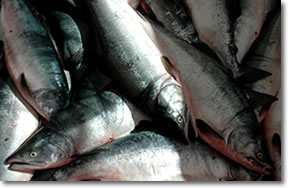
Of the eight fishery management regions, New England is at the bottom of the list for recovering ailing fish stocks, according to Andrew Rosenberg, the report's chief author and a professor of natural resources policy and management at the University of New Hampshire.
New England has the most stocks at unhealthy levels, with 18 stocks under rebuilding plans. Only two - haddock and sea scallops - have reached healthy levels or are no longer over- exploited, according to the study.
"Nearly half of the stocks for which there are rebuilding plans are still subject to overfishing," the study concludes, "so that fishing pressure is still too high to allow recovery."
The study looks at the nine-year period that followed the 1996 changes to the federal Magnuson-Stevens Fishery Conservation and Management Act, which require depleted fish stocks be rebuilt within a 10-year time limit.
The study's publication comes as Congress prepares to amend the act again. The Senate in June approved updated fisheries rules that have the support of many conservationists.
However, Rep. Richard Pombo, R-Calif., who chairs the House Resources Committee, is pushing a bill in the House that would weaken the law's rebuilding provisions.
Rep. Tom Allen, D-Maine, who co-chairs the House's Ocean Caucus, is working with both Republicans and Democrats to offer an alternative to the Pombo bill that would be closer to the Senate version.
According to Rosenberg's study, federal managers have allowed for numerous delays in implementing recovery plans, and too often they have pushed back deadlines. Moreover, monitoring has been inconsistent or absent, and managers have failed to revise plans that are not working, the study said.
"The one thing that surprised me the most," Rosenberg said in an interview, "is that in so many cases, even though the stocks have been under a rebuilding plan for a number of years, overfishing was still going on."
In New England, he said, fishermen are often allowed to continue to overfish a stock even if they have exceeded fishing limits the previous year by as much as 50 percent.
In almost half the rebuilding cases, managers don't have key information about fishing pressure or fish abundance to determine whether a population is rebuilding, the study contends.
The study, "Rebuilding U.S. Fisheries: Progress and Problems," will be published next month in Frontiers in Ecology and the Environment. It provides a breakdown of the condition of fish stocks for each of the eight fishery regions.
Rosenberg said he spent more than a year on the study, which relied on previously published information from regional councils and the National Marine Fisheries Service.
Rosenberg's perspective is broader than that of a scientist. From 1994 to 1998, he was regional administrator for New England with the fisheries service. From 1998 to 2000, he worked in Washington as the agency's deputy director.
Allen said Rosenberg's study is further evidence the Magnuson-Stevens Act has not worked as well as intended. The task is daunting, he said, because both the fish stocks and the fishing industry need to thrive.
"The fundamental conflict is that we can't destroy the fishing industry to rebuild the fish stocks," he said, "but we have to have tight enough regulations that the fish stocks can recover within a reasonable time. How to do that is going to be controversial and difficult in the best of circumstances."
"I THINK THE SYSTEM IS FAILING"
Under the current system, the slow rebound of some groundfish stocks, such as cod, is hurting fishermen in Maine, said Commissioner George Lapointe of the Maine Department of Marine Resources.
Between 1996 and 2005, the number of active permit-holders for groundfish dropped from 178 to 124, and groundfish landings in the state declined by 26 percent.
Lapointe, who sits on the New England Fishery Management Council, said he agrees with a lot of facts in Rosenberg's study. He said people involved in fisheries management in New England need to set aside their ideological agendas and short-term interests and re-examine the system with open minds.
"We have met the enemy, and it is us," he said. "People have tried so hard to make this work - the managers and the fishermen - and we haven't done the job. I think the system is failing, and we need to change."
Tom Hill, a Gloucester-based marine surveyor who has been on the New England council for 14 years, said the Rosenberg study accurately reflects the difficulty of developing effective fishing policies in a system plagued by "short-term political expediency."
But others say the study paints a misleadingly bleak picture with a selective use of facts.
While it's true that not many of the stocks have been rebuilt to date, most have not reached their rebuilding deadlines yet, said Gaylen Tromble, chief of the domestic fisheries division at the fisheries service.
"Rebuilding for a lot of stocks is a process that takes quite a bit of time," he said.
Moreover, by focusing on fish stocks identified as overfished, the study ignores the fact that 74 percent of the nation's fish stocks aren't overfished, said Susan Buchanan, a spokeswoman for the fisheries service.
OWNER EXPRESSES CONCERNS
Barbara Stevenson, an owner of large groundfish vessels based in Portland and a former council member, agrees.
"It's like saying all the sick people aren't getting well," she said. "But there are a whole lot of healthy people running around."
Stevenson said the Magnuson-Stevens Act requires fisheries managers to balance the need to rebuild fish stocks with the needs of the fishing industry to stay in business. If fishermen are out of work, ice suppliers and processing plants would close down, too.
"To maintain the shoreside infrastructure has always been a special goal of our industry," she said. "We know we would never get it back if we lost it."
By TOM BELL, Portland Press Herald Writer