
|
|
|
International Whaling History Revisits AlaskaMarch 3, 2007By Stephen Taufen - Many international news stories have recently pointed out that the International Whaling Commission (IWC) will be meeting in Anchorage, Alaska from May 4 to 31, 2007. Of central concern will be the commercial whaling by Japan that hides underneath the alleged practice of "scientific research." For more information and an agenda, see: http://www.iwcoffice.org. 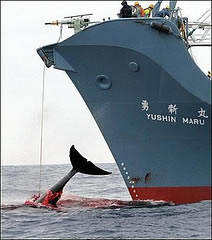
This reminds us of how U.S. senator Ted Stevens hides whale-sized global fisheries corruption and allocation of public resources to special interests under the mantra of "conservation." Because the bottom line of these commercial fisheries, just like pollock and crab and rockfish "rationalization" takings in Alaska no matter how hard they try to call it science is an economic war for protein and perpetual corporate profits. For the economic enemy is not shy to employ illicit accounting methods on a global scale, through Abusive Transfer Pricing (ATP) practices that deny governments rewards, while sticking the costs to the People. And it will be interesting to see if the mainstream media merely feeds on easy propaganda krill or searches for the underlying truths this May. In any case, with the IWC's 59th Annual meeting taking place in "home territory" for Stevens and his cronies - many currently under suspicion in Justice Department public integrity probes - the tension of having a majority of Alaska's fisheries in the hands of Japan's cartel may come home to roost. It could be that the issues of World Trade Organization subsidies, unfair conduct of trade and related legal concerns finally surface and blow Alaska water, too. Here are two primers to help readers understand some background issues. First is a short reminder of how Japan misbehaves in whaling, and related legal concerns, which could be further explored by media in the upcoming months. Second, to add a little discipline to Ted Stevens and his cronies, we'd like to republish an article that sheds light on how past behind-the-scenes United States dealings with Japan's whaling industry had long ago shored up, in part, the hegemony Japan's cartel increasingly enjoys today in Alaska's fisheries, as well. Unilaterally Harpooning Science: In the summer of 2000, Japanese whalers began harpooning Bryde's and sperm whales under the euphemism of "scientific research." U.S. law protected both species. However, this alleged scientific research was permissible under International Whaling Commission rules. In September 2000, the Clinton White House declared that Japan violated international whaling rules, boycotted a United Nations meeting in Japan, and drew up lists of Japanese goods that could be banned from United States markets. The Japanese indicated they would take the case to the World Trade Organization in Geneva, should such sanctions be imposed. And then-Agriculture, Forestry and Fisheries Minister Yoichi Tani challenged then-Secretary of State Albright by angrily noting how many sardines whales eat, and by saying, "Does the U.S. think that it should decide everything and that Japan will back down if it glares?" Albright conveyed "strong disappointment" over Japan including endangered species in its whaling program. Japan cranked up the tension with false information until the IWC's Scientific Committee reported appreciably lower minke whale stocks than Japan reports, which had wrongly claimed "the Southern Ocean is invested with vast numbers of minke whales, the 'rabbits of the seas'." The dispute continued and Australia considered bringing a challenge in the International Court of Justice because "legal opinions suggest that Japan's unilateral scientific whaling is an abuse of its obligations to the IWC." The legal opinion was that if the whaling was for Japanese commercial purposes rather than scientific ends, it could breach established legal principles concerning good faith, abuse of rights, and the UN's precautionary approach to harvesting wild species. Australia and New Zealand had already forced Japan to halt "experimental fishing" for bluefin tuna, and the "abuse of rights" legal doctrine was effectively used against the U.S. for its ban on shrimp imports from Thailand. It concerned use of environmentally favorable technologies regarding desired protections of turtles, versus Thailand's economic rights. And a key concern in the Southern Ocean Sanctuary was that Japan's whaling undermined the sanctuary's purpose and intent. To get its way at the IWC, Japan had aligned with multiple Caribbean nations that were termed "havens for organized crime, drug cartels, tax-evasion, and corrupt officials." Japan was giving financial aid to these countries, despite Organization of Economic Cooperation and Development (OECD) concerns about these "non-cooperative" nations engaged in money-laundering, and expecting and receiving their support against the United States and other countries that were challenging Japan's whaling programs. Profit Laundering Explains Underlying Truths: Groundswell was following these activities not only because of the familiar employment of "offshore havens" in Japan's corporate fishing industry, but also because the Internal Revenue Service had halted taking further action against at least two Japanese fishing multinationals who we'd turned in for federal tax evasion across international borders. The Large- and Medium-Sized Business office within the IRS had incorrectly concluded that these companies did not have any highly liquid assets from which further IRS recoveries could be readily taken. However in the case of Nippon Suisan alone, Japan's second-largest fishing multinational, no sooner had the IRS stopped deeper pursuits than cash started rolling into other global ventures. It was in early 2001 that Nissui paid over $80 million for a New Zealand firm in large part to secure access to farmed salmon meal-feedstocks off South America. Then in August 2001, Nippon Suisan purchased Unilever's North American seafood business, a $175 million cash deal comprised of Gorton Seafood's in the United States and BlueWater Seafoods in Canada. Nissui already owned Fishking Processors, Inc. based in Los Angeles and UniSea, Inc. based in Washington state, with a key surimi plant in Dutch Harbor, Alaska. It was an embarrassing moment when I explained this "readily available cash" outlay of $255 million to the LMSB manager in the Seattle federal building at IRS offices, just months after they informed me they had ratcheted down investigations. He was also exasperated at the lack of commitment at the uppermost levels of the IRS in taking the "Abusive Transfer Pricing" in Alaska's seafood industry far more seriously. However, compared to other industries, one worth a few billion dollars was not considered worthy of more criminal and audit division investment, especially given the Byzantine structure these fishing companies employed to hide activities, transactions and funds. But that's the nature of the problem when a multinational resource acquisition corporation is intent on abusing all nations who would attempt to exercise any control - be it for taxes or the environment - over their global affiliates. When corporatism so overwhelms world governments and hegemonies steal billions of dollars annually, they can use those funds to fuel propaganda and other "fight back" campaigns against law-abiding world citizens, and that makes it complicated to change things. But we've never had any help from those who should have helped. Groundswell doesn't recall Ted Stevens getting very tough on Japan a decade ago on the whaling issues, but he is making a lot of noise about it now. It follows his putting-on-a-good-show path of appearing to be conservation oriented while sneaking special interest deals and economically harmful corporate privatization (allocation of public resources) measures into the Magnuson-Stevens Fisheries Conservation and Management Act. However, we'll never forget when Stevens told the U.S. Senate over the Steller sea lion rider, which would have landed over $230 million into the hands of the Japanese corporately-owned multinational fish companies, where he really stood. He unapologetically spouted, "You have to understand that Alaska is a lot closer to Tokyo than to Washington D.C. Ted Stevens has never shown any of the true intent and spirit of Americanization as promised by the Magnuson Fisheries Act in 1976-78, and has completely ignored the massive tax evasions he is fully aware are occurring. Instead, he coddled Japan's fishing cartel's maritime hegemony over Alaska's fisheries, too - by giving them rights on a level above those they held prior to the MSFCMA fueling a growing hegemony over tuna and whaling, as well. By this, he greatly assisted formation of a Thalassocracy (a maritime regime) rather than freedom and liberty, and open and fair conduct of global trade for all competitors. History Reveals Japan's Whaling Lies: Nearly a decade ago Groundswell had already met with an Australian university researcher who was delving into our efforts to deal with Japan in the North Pacific on abusive Transfer Pricing issues. Australia and New Zealand, along with a host of southern Pacific Ocean nations, were equally concerned about how Japan's fishing corporations used the illicit accounting techniques of "cross-border product laundering" to embezzle the profits away from their tax authorities' reach. Several took action to protect their tax coffers and economies from transfer pricing abuses (especially where underreported and illegal fisheries were also involved), particularly in tuna and other fisheries. Is it only the United States under Ted Stevens' thumb that fails miserably to protect its coastal communities and harvesters' rights? Stevens and the Bush Administration might come to Anchorage in May loaded with back-door dealings already in place and fail us once again. It would not be untypical for them to consider the People beneath an understanding of the lofty affairs of and between nations, where undisclosed ends typically justify their historical means. We think many Alaskan fishermen will be surprised to read the sunlit piece below, especially considering the eventual outcome of Unilever's investments, above. "Japan's Whaling Propaganda Goes Overboard--Along With the Meat" "The Japanese government has launched a propaganda blitz in Australia and elsewhere to defend its outlaw whaling. A powerful international public relations agency is spreading misinformation, including mass mailings to residents of Adelaide. "One of the deceptive claims is that the Japanese people have been dependent upon whale meat for centuries and that it is vital to the national diet. "But the Japanese government is covering up the truth. In reality, there was very little whale meat consumption in Japan until after World War II. A handful of fishing villages historically caught a few whales by netting or harpooning - or salvaging dead whales - just as fishing villages did around the world for hundreds and even thousands of years. The few hundred tons of whale meat produced annually in Japan were only consumed by locals--there was no refrigeration or transportation to the cities. Until after World War II, there was no large-scale market for whale meat in Japan or anywhere else in the world. It was whale oil and whale bone that drove the hunt in every ocean for centuries. "Indeed, Japan entered large-scale, deep-sea whaling not to feed its people but to finance its conquest of Manchuria and China. Professor George Small described Japan's motives for industrial whaling in his landmark 1971 history of whaling, The Blue Whale: "Japanese pelagic whaling began with the 1934/35 season, and by 1939 operations had expanded to a total of 6 floating-factory expeditions. During those years several international agreements, designed to prevent overexploitation of stocks of whales, were reached under the aegis of the League of Nations. The agreements included standard prohibitions such as the killing of the nearly extinct Right whales, suckling calves of all species, and females accompanied by a calf. Japan refused to abide by any of the agreements. Moreover, Japan refused to participate in the negotiations leading to the agreements even when for her benefit the North Pacific, her oldest whaling area, was specifically excluded. 'The reason for the refusal to accept even rudimentary conservation practices was the urgent demand placed on the Japanese economy by the country's war in Manchuria and China. All the pelagic fleets sent to the Antarctic were owned and operated by the Nippon Suisan Kabushiki Kaisha Company, the main shareholder of which was the Manchurian Heavy Industries Corporation. This corporation was the principal economic and industrial arm of the Japanese army in Manchuria. The objective of the Nippon Suisan Company, as stated in the 1941 Mainichi Yearbook, was the acquisition of foreign currency and food supplies for the Japanese armed forces.' "Tens of thousands of tons of whale oil was sold by Japan in Europe, particularly to the Anglo-Dutch Unilever Company, which had developed the method of turning whale oil into edible margarine. Hundreds of millions of dollars of weapons, mostly from Germany and England, were purchased with the proceeds from the plunder of the whales. "But what happened to the billions of pounds of whale meat from the carcasses of tens of thousands of blue, fin, right and humpback whales slaughtered by the Japanese fleet in the Southern Ocean? Not one pound of it was sent back to Japan to feed the so-called "need" for whale meat there. It was all dumped overboard! "Why was this mountain of whale meat ditched at sea after the whale blubber was stripped off the whales? Because there was no demand for whale meat in Japan. Indeed, the Japanese fishing industry and farmers won a ban on whale meat imports from the pelagic whaling fleets, fearing rightfully that such a deluge of meat would destroy the domestic markets for fish, beef, pork and poultry. "It was only after World War II when the ruined, destitute nation needed quick supplies of food that Japan began consuming large quantities of whale meat. The U.S. occupying force directed Japan to build new whaling fleets. Japan was to consume the whale meat taken; the U.S. took the whale oil in return for financing the fleets. By the early 1950s millions of tons of whale meat were feeding the Japanese people from the whale kill. The Japanese whaling industry became the largest in the world because it profited not only from whale meat, but also from whale oil after the U.S. investment was paid off. Japan led the final destruction of the last of the great stocks of blue, fin and humpback whales in the Southern Ocean. "The carnage peaked in 1963 with more than 20 nations hunting the giant marine mammals. The International Whaling Commission, finally taking action, banned the taking of the most endangered species. By then, Japan had a strong economy and could afford to buy food overseas. The demand for whale meat dropped steadily through the 1970s Unfortunately, Japan's whaling industry evaded the IWC bans by setting up outlaw whaling operations around the world to hunt down the last hundreds of blue, humpback and right whales from land stations around the Pacific and with pirate ships roaming the Atlantic and Indian Oceans as well as the Pacific. "Today Japan is an exceedingly wealthy nation that imports the best foods from every corner of the world. There is no longer any "need" for whale meat. Indeed, the whale meat from Japan's outlaw "research" whaling is a high-priced exotic delicacy. It is less than one hundredth of one percent of Japanese meat consumption. But the Japanese government deceitfully claims that whale meat is 'vital'." Conclusion: It is morally significant that, to this day, the population of Pacific Ocean whales was affected by the 1930's whaling practices of Japanese trading companies, and subsequent State Department political solutions that also affect the capitalization of fisheries today. After all, the guns used in the Rape of Nanking were paid for by whaling product sales to Unilever, who sold future seafood companies right back to the soulless trading company long-ago involved. So it's no stretch to say Alaskans have a right to expect better representation across all aspects of fisheries, and to improved protections against this boundless economic and resource hegemony. Dr. Hogarth of NOAA Fisheries and Senator Ted Stevens may talk tough, but both are experts at avoiding the real secrets of the global temple. So if there is going to be a successful outcome from May's IWC meeting, full Accountability and Transparency must occur. They must ensure that the State Department fully understands how multinationals are employing Abusive Transfer Pricing in the unfair Conduct of Trade. There's a lot at stake for Alaska's indigenous whalers and their villages, and they should not have to face the decade's long propaganda of the Japanese media Wurlitzer any longer, without a little support. We hope they, especially, have enjoyed this historical reminder. By Stephen Taufen, Groundswell Fisheries Movement A public watchdog and advocate for fishermen and their coastal communities. Taufen is an "insider" who blew the whistle on the international profit laundering between global affiliates of North Pacific seafood companies, who use illicit accounting to deny the USA the proper taxes on seafood trade. The same practices are used to lower ex-vessel prices to the fleets, and to bleed monies from our regional economy. Contact Stephen Taufen |
|